Is Bitcoin a Good Investment for Beginners? (2026 Guide)
Is Bitcoin a good investment for beginners right now, or is it too late to buy? We provide a brutal reality check and honest answers to your questions. Skip the hype and learn the professional strategies that separate the 5% of winners from the 95% who lose. Learn to invest wisely rather than gamble on Bitcoin.
Is Bitcoin a Good Investment for Beginners? (2026 Reality Check)
The question on every new investor's mind in 2026 is simple: Is Bitcoin a good investment for beginners, or is it too late to buy Bitcoin? With the market maturing and institutional giants like BlackRock and Fidelity now treating BTC as a core asset, the answer is a definitive yes: Bitcoin is still a good investment. But with a massive caveat.
Bitcoin is a phenomenal tool for long-term wealth preservation, yet it remains a "face-melting" trap for those who treat it like a lottery ticket. While the era of buying BTC for pennies is over, we have entered the era of "Institutional Adoption," where the real money is made not by catching a lucky pump but by mastering the cycle. So, if you are ready to stop guessing and start treating your portfolio like a professional business, this guide will show you exactly how to succeed in 2026 by investing in Bitcoin.
First, let us begin with the first question: How Much Should I Invest? For most beginners, the smartest move is to invest no more than 5% of your total investable savings into Bitcoin. Top financial institutions such as Bank of America now recommend a 1% to 4% allocation for wealth and private banking clients to capture upside while ensuring a market dip doesn't derail their real-world financial stability. See the table below for recommendations.
The 2026 Reality Check: Is It Too Late to Buy Bitcoin?
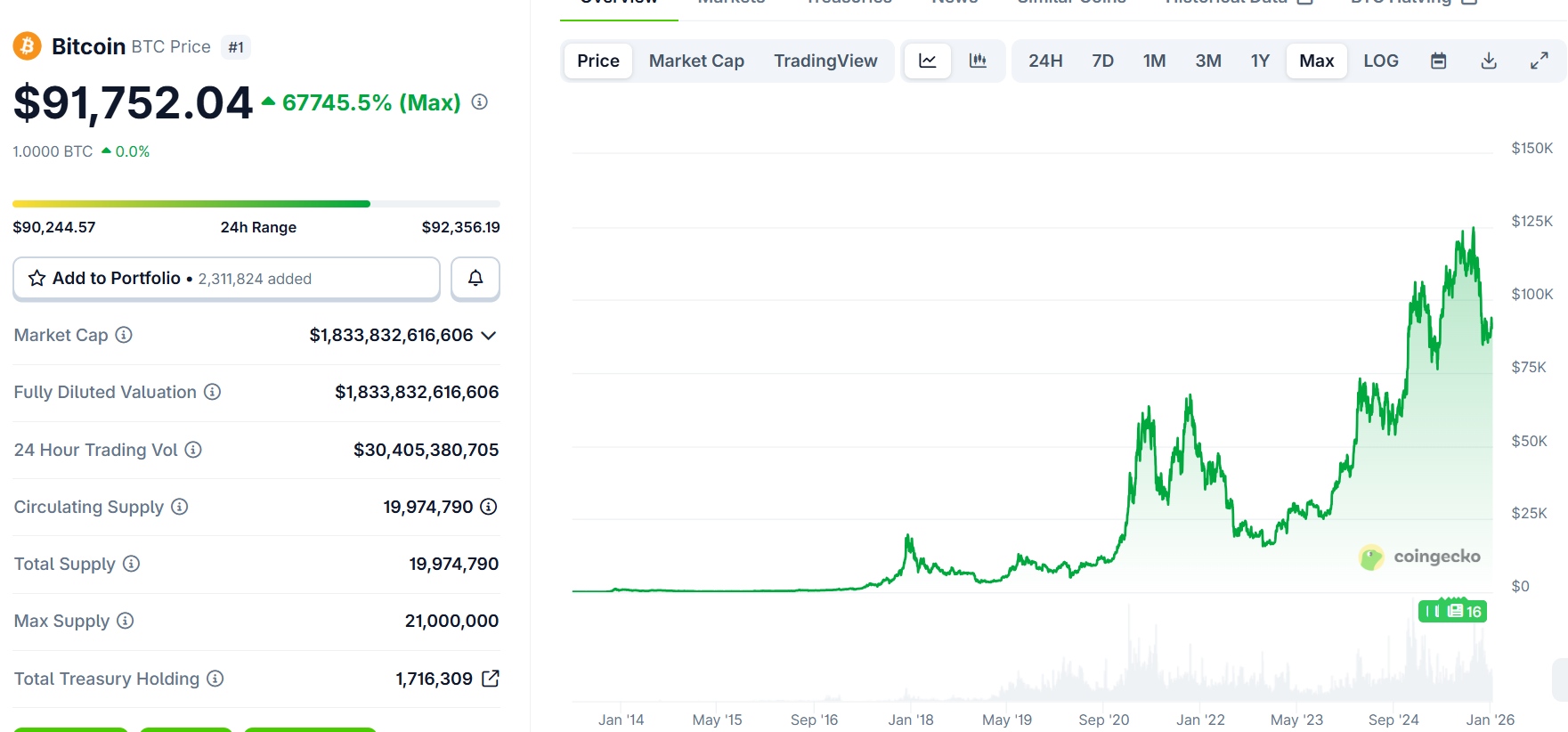
This is the #1 fear new investors have. Today, when you look at the price chart, you might think you missed the boat. But in reality, you didn't. Based on the current sentiment, it is not too late to buy Bitcoin. However, you are no longer "early" in the sense of buying it for pennies. You are now buying alongside institutions in the adoption phase. See the BTC-USD chart below.
This article is your simplified Bitcoin for beginners guide, designed to move you past the hype and give you the facts you need to survive. Now, let's proceed to analyzing...
The Truth About Bitcoin Investing (Risk vs. Reward)
To understand if this is right for you, you need to understand the mechanism. First, how does Bitcoin make money? Unlike a stock, Bitcoin does not pay a dividend or yield (unless you lend it out, which adds risk). It makes money through scarcity.
There will only ever be 21 million Bitcoins. As governments print more fiat currency and institutions (like BlackRock and Fidelity) buy up the limited supply of Bitcoin, the price appreciates against the dollar.
Despite Bitcoin being referred to as "hard money" in the crypto space, many beginners often ask, "Is crypto worth it for beginners?" or should they stick to stocks? Bitcoin is generally considered the "safest" entry point into the wider crypto world. While altcoins act like penny stocks (high risk, high failure rate), Bitcoin acts more like digital gold. It is the reserve asset of the entire ecosystem.
Before you decide whether Bitcoin is a good investment for you in 2026, let us run some safety checks.
Protocol vs. Price
We need to distinguish between two types of safety:
Protocol Safety: The Bitcoin network has never been hacked. It is arguably the most secure computer network in the world.
Investment Safety: The price of Bitcoin is volatile. It can drop 20% in a week. If you need your money back in the short term, Bitcoin is not safe. If you can wait 4+ years, historically, it has been incredibly safe.
How Much Should You Invest as a Beginner?
We gave you the rule of thumb above, but let’s dig deeper into how much to invest in Bitcoin as a beginner.
The biggest mistake rookies make is asking, "Should I put all my money in Bitcoin?" The answer is a hard NO. Bitcoin is a volatile asset. If you go "all in," you will emotionally panic when the price drops (and it will drop). You will sell at the bottom and lose everything. A 1-5% allocation allows you to sleep at night. If Bitcoin doubles, you make a meaningful profit. If it drops 50%, your overall financial life is not ruined.
Budget-Friendly Options
You do not need to be rich to start. The minimum amount to invest in Bitcoin on most exchanges is often as low as $10 or $20. You don't have to buy a "whole" Bitcoin. You can buy fractions, known as "Satoshis" (or Sats).
$50 can buy you hundreds of thousands of Sats.
This dismantles the myth that you need thousands of dollars to enter the market. However, investing $50 in Bitcoin won't change your life nor grant you financial freedom. Now, let's analyze...
The Smart Strategy: Dollar-Cost Averaging (DCA)
If you want to avoid stress, you need a safe Bitcoin investment strategy. That strategy is Dollar-Cost Averaging Bitcoin (DCA).
What is DCA?
Instead of trying to time the market (buying everything at once), you buy a fixed dollar amount at regular intervals.
Example: Buy $100 of Bitcoin every Friday, regardless of whether the price is up or down.
Why It Wins
DCA removes emotion. When prices are high, you buy less Bitcoin. When prices are low, you buy more Bitcoin. Over time, this lowers your average entry price. For 90% of people, this is the best way to buy Bitcoin for beginners.
The Professional Pivot: Timing the Cycle
However, DCA has a limitation: it buys blindly. While DCA ensures you don't lose, professional investors who want to maximize wealth use a more advanced approach. They combine DCA with a Bitcoin timing model tool.
There is a big difference between long-term crypto holding vs trading.
Holders buy and hope.
Investors use data.
By using a timing model, you can identify when Bitcoin is mathematically "overheated" (a good time to slow down buying) and when it is in a "deep value" zone (a good time to increase your buying). This doesn't mean day trading; it means adjusting your strategy in response to market cycles. This is the skill that separates those who just "make some money" from those who build life-changing portfolios.
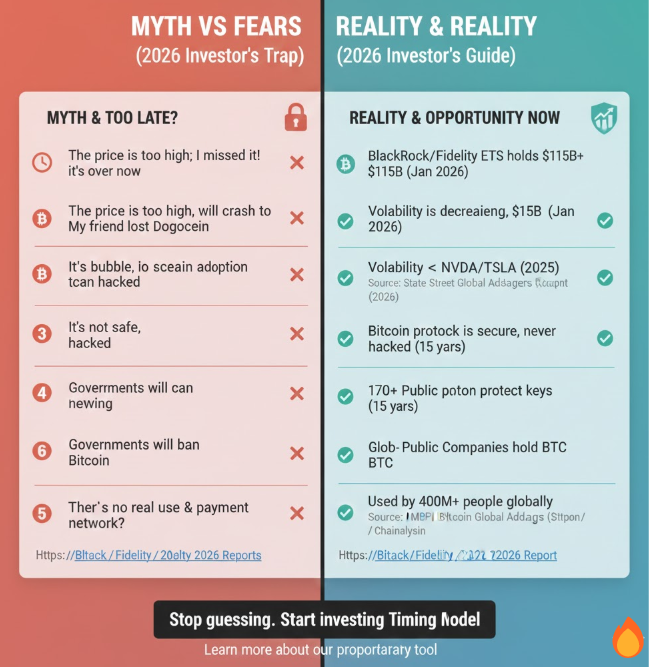
Now, take a look at the "Myth vs. Reality chart below.
Should You Buy Spot Bitcoin or an ETF?
In 2026, you have two main choices.
This means buying actual Bitcoin on an exchange like Coinbase or Binance.
Pros: You own the asset. You can use it to pay for things. You are independent of the banking system.
Cons: You are responsible for security (passwords/seed phrases).
The Bitcoin ETF for beginners has exploded in popularity. This allows you to buy Bitcoin through your regular stock brokerage account or 401k.
Pros: extremely safe (regulated), easy to buy/sell, tax advantages in IRAs.
Cons: You pay a management fee (expense ratio). You don't actually "own" the Bitcoin; you own a share of a fund.
Verdict: If you are tech-savvy, buy Spot. If you want simplicity and tax benefits, buy the ETF.
3 Major Risks You Must Know
We cannot talk about rewards without talking about the risks of investing in Bitcoin.
Volatility: Can you lose money on Bitcoin? Yes. If you buy at the top of a hype cycle and sell three months later during a correction, you will lose money. Remember: Unrealized losses only become real losses if you sell.
Security: Crypto wallet security is paramount. If you buy Spot Bitcoin, you must learn about "self-custody." If you lose your password (private key), your money is gone forever. There is no "forgot password" button in crypto.
Scams: Be wary of anyone promising "guaranteed returns." If someone asks you to send them Bitcoin so they can "double it," it is a scam.
Conclusion: The Long Game
So, let's look at the Bitcoin price prediction 2026. While experts remain bullish on the long-term trajectory due to institutional adoption and supply scarcity, nobody has a crystal ball.
Investing in Bitcoin is a test of patience, not IQ. If you treat it like a get-rich-quick scheme, the market will punish you. If you treat it like a savings technology and apply a professional strategy—using DCA and Bitcoin timing model tools—you place the odds significantly in your favor.
Don't wait to buy Bitcoin; buy Bitcoin and wait. But do it with a plan, not a prayer.
Thanks for reading.
P.S. Need More Help and Resources?
Buy and sell crypto on Bybit, my preferred crypto exchange.
Download the Crypto Traders’ Handbook
Download Your AltSeason Blueprint
Upgrade Your Subscription to receive a copy of the BTM user’s guide.