What Will Happen When 100% of Bitcoin is Mined? (2026 Guide)
The countdown to 2140 has begun. With over 94% of Bitcoin already mined, the transition from block rewards to a fee-only economy is the most critical shift in financial history. Here is how it works and what it means for your portfolio.
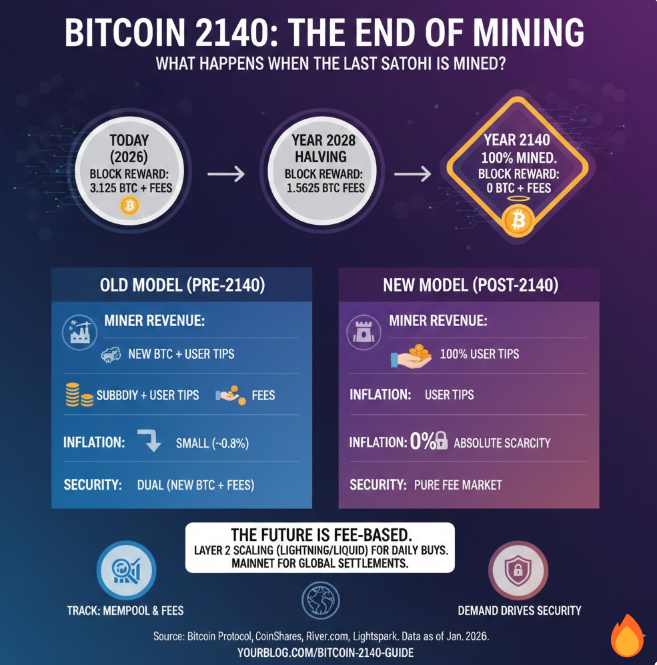
What Happens When 100% of Bitcoin is Mined?
Let us think about Bitcoin's future for a moment. Bitcoin has a 21 Million Hard Cap baked into its source code. Based on the current Bitcoin Halving Schedule, the Year 2140 is the definitive date when the final satoshi will be mined. After this, the End of Block Rewards occurs, and the network will transition to a Transaction Fee-Only Model, where miners are compensated exclusively by users rather than new coin issuance. By 2140, new issuance drops to zero, and according to Investopedia, miners will rely solely on fees to secure the network. But here is the reality check: we don't have to wait 100 years for the impact. In 2026, we have already surpassed the 94% mined milestone, meaning the scarcity we are trading today is already 9/10ths of the way to its final state. Now, let us look into...
The Deflationary Clock
As you may know, the 100% mined state is not a sudden event, but a gradual tapering. Every 210,000 blocks (roughly four years), the amount of new Bitcoin created is cut in half. Now, we are approaching an asymptote, not a cliff. By the time we enter the 2030s, over 99% of all Bitcoin will already be in circulation, making the remaining century of mining a long, slow "tail." And that takes us to the supply issue...
Supply Dynamics: The Final 1%
The final 1% of the supply—roughly 210,000 coins—will take over 100 years to mine. This deliberate design ensures the network has ample time to mature its fee-based economy. As an investor, the "supply shock" is a present reality: after the 2024 halving, daily issuance dropped to 450 BTC, and it will drop again to 225 BTC in 2028. Now, let's analyze the maths behind Bitcoin...
Absolute Mathematical Scarcity
Bitcoin offers a "reality check" against traditional finance. While central banks can print trillions via Modern Monetary Theory, Bitcoin's supply is governed by Absolute Mathematical Scarcity. This makes it the only global asset with a supply curve that is entirely independent of its price or demand. But what happens when the entire Bitcoin is mined?
Life After Subsidies: The Transaction Fee-Only Model
First, Let Us Begin With the Shift in Miner Revenue
Currently, miners receive a Block Subsidy plus Transaction Fees. In 2026, the subsidy remains the dominant income (3.125 BTC per block). However, as the subsidy disappears, miner revenue will shift entirely to the fees paid by users to have their transactions included in a block. See the comparison table below.
Comparison Table: Current vs. Post-2140 Economics
Network Security Sustainability: Can Fees Secure the Chain?
The Security Budget Debate
A common factor often ignored is the Security Budget. Critics argue that without subsidies, miners might leave, causing Hash Rate Volatility. However, I don't believe that argument is sound because it ignores the evolution of the Fee Market, which incentivizes security through competition for limited block space.
Look, as Bitcoin evolves into a Global Reserve Asset, the demand to settle high-value transactions on the main chain will grow. This creates Mempool Competition, ensuring that even without new coins, aggregate fees provide a sustainable security budget to keep the network robust.
What About the 51% Attack Risk Post-2140?
People often ask whether the Bitcoin network is hackable without subsidies. The answer is No. The cost of energy and specialized ASIC hardware remains the ultimate barrier. An attacker would still need to outspend the collective power of the global mining fleet, which stays high as long as transaction fees remain valuable. Let's discuss the role of L2 and lost BTC.
The Role of Layer 2 Scaling and "Lost" Bitcoin
Layer 2 Scaling Solutions
On-chain fees will likely make buying coffee on the mainnet uneconomical. Instead, the world will use Layer 2 Solutions like the Lightning Network for daily payments, while the Bitcoin mainnet functions as a settlement layer for larger, institutional transfers.
You see, the 21 million limit is not a barrier to adoption because Bitcoin is highly divisible. One BTC contains 100 million Satoshis, allowing the network to support global commerce even if the price of a single Bitcoin reaches millions of dollars.
In my view, investors must also account for Lost Bitcoin. Estimates suggest that 3.7 million BTC are permanently lost due to lost keys or the "Satoshi stash." This means the effective circulating supply is much lower than 21 million, drastically increasing the rarity of the remaining coins. That brings us to the governance and hard fork...
Protocol Governance and Hard Fork Resistance
Who Controls the 21 Million?
Unlike central banks, Bitcoin has no CEO. It is governed by Decentralized Protocol Governance, where tens of thousands of independent nodes enforce the rules. To change the supply cap, one would need near-unanimous consensus from every node operator—a move that would devalue their own holdings. And that brings us to another level of discussion...
Hard Fork Resistance
Attempts to change the cap in the past have resulted in Hard Forks, such as Bitcoin Cash. However, the market has consistently chosen the original chain with its fixed supply, demonstrating Bitcoin's immense Hard Fork Resistance and commitment to its 21 million limit. Finally, let's discuss the transition of Bitcoin from a speculative asset into a global asset.
The Transition to a Mature Financial Asset
The year 2140 isn't an expiration date; it's the beginning of Bitcoin's life as a finished, perfectly scarce commodity. As an investor in 2026, your job is to look past the "mining" phase and recognize the emergence of a global, sovereign store of value. Now the question is, how much Bitcoin do you own?
P.S. Need More Help and Resources?
Buy and sell crypto on Bybit, my preferred crypto exchange.
Download the Crypto Traders’ Handbook
Download Your AltSeason Blueprint
Upgrade Your Subscription to receive a copy of the BTM user’s guide.
FAQ: People Also Ask:
1. When exactly will the last Bitcoin be mined? Based on the current Bitcoin Halving Schedule, the final satoshi is projected to be mined in the year 2140.
2. Will Bitcoin miners stop working after the 21 million limit is reached? No. Miners will still be required to validate and secure transactions. However, their compensation will shift from newly minted coins (block subsidies) to earning 100% of the transaction fees.
3. Will transaction fees become too expensive for regular users? While mainnet fees may rise, Layer 2 solutions like the Lightning Network and Liquid will handle microtransactions, keeping daily use affordable while the main chain serves as a high-security settlement layer.
4. Can the 21 million Bitcoin limit be increased? Technically, the code can be changed, but it requires overwhelming consensus from nodes, miners, and users. Since increasing the supply would devalue their own holdings, such a change is widely considered "economically impossible."
5. What happens if I lose my Bitcoin after mining ends? Lost Bitcoin cannot be recovered. As coins are lost over time due to forgotten keys, the effective circulating supply actually shrinks, which can increase the value of the remaining coins.
6. Is the Bitcoin network less secure without block rewards? Critics argue this creates a "security budget" risk, but proponents believe the growing demand for block space will generate enough fee revenue to keep the network's hash rate at record highs.
7. How many Bitcoins are left to mine in 2026? As of early 2026, approximately 1.3 million BTC remain to be mined, as over 94% of the total supply is already in circulation.
8. What is a "Satoshi" and why does it matter for the 21 million limit? A Satoshi is the smallest unit of Bitcoin ($10^{-8}$ BTC). Because Bitcoin is infinitely divisible, we don't need "more" coins; we simply use smaller units as the value grows.
9. Why did Satoshi Nakamoto choose 21 million? While the exact reason is a mystery, it is believed to be a mathematical choice that balances the 10-minute block time with a 4-year halving cycle to ensure a steady, deflationary issuance.
10. Will the price of Bitcoin go up when 100% is mined? In theory, absolute mathematical scarcity combined with rising demand leads to price appreciation. However, the market usually "prices in" this scarcity decades before the actual deadline.