What Investing Apps Can I Use at 16? (2026 Guide)
Looking for what investing apps you can use at 16? Compare Fidelity Youth, Greenlight, UTMA custodial accounts, and crypto rules for under-18 investors.
Key Takeaways
Fidelity Youth Account is the primary app allowing 16- and 17-year-olds to execute their own stock and ETF trades with parental oversight and zero subscription fees.
Minors under 18 cannot legally open standard brokerage or crypto exchange accounts alone due to federal Know Your Customer (KYC) laws and contract enforceability rules.
Parent-supervised custodial options like Greenlight, Acorns Early, Bloom, and Charles Schwab UTMA allow parents to invest on behalf of a minor.
Direct crypto trading on platforms like Coinbase or Kraken is restricted to ages 18+; under-18s can gain legal crypto exposure through spot crypto ETFs (such as IBIT or FBTC) inside custodial accounts.
Starting to invest at age 16 gives your money a ten-year head start over most peers, allowing compound growth to work far more aggressively over your lifetime.
What Investing Apps Can I Use at 16? The Complete Guide to Minor Investing
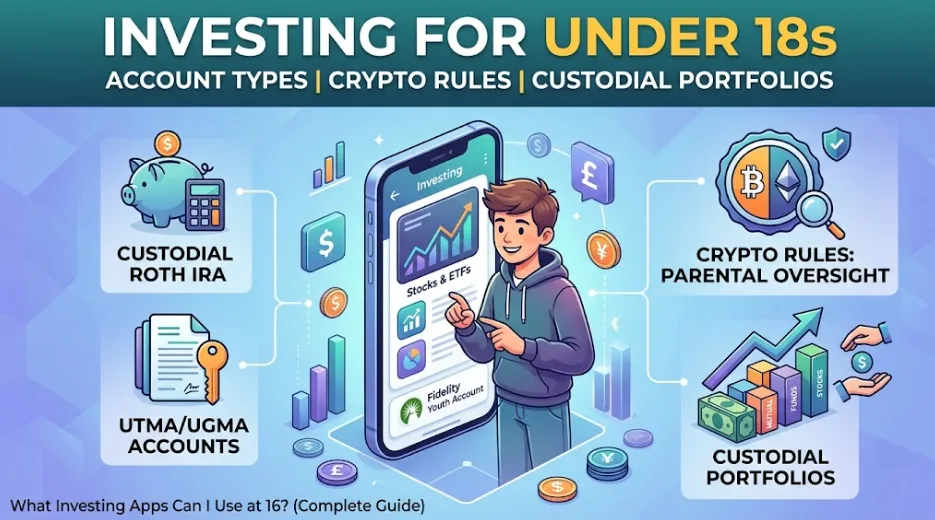
At age 16, you can trade stocks and exchange-traded funds (ETFs) directly using the Fidelity Youth Account, which gives 13- to 17-year-olds direct trading access under parent oversight. And if you prefer automated investing or parent-managed portfolios, you can use custodial apps like Greenlight, Acorns Early, Bloom, or traditional custodial accounts (UTMA/UGMA) at Charles Schwab and Interactive Brokers. Because federal Know Your Customer (KYC) regulations and contract law prevent minors from opening solo accounts, all legal investing platforms for 16-year-olds require a parent or legal guardian to co-sign or manage the setup.
As of September 2026, the financial technology space offers several distinct paths for teenage investors. Understanding which app fits your goals depends on whether you want to choose your own stocks or have your parents manage your assets.
What Investing Apps Can I Use at 16? (App-by-App Breakdown)
The table below breaks down the top investing platforms available to 16-year-olds, detailing costs, who controls the trades, and primary features.
1. Fidelity Youth Account
The Fidelity Youth Account remains the most flexible choice for 16-year-olds who want hands-on experience. Unlike standard custodial accounts where only adults can place orders, this account lets you buy and sell US stocks, ETFs, and Fidelity mutual funds directly from your phone.
How it works: A parent must hold an active Fidelity brokerage account to initiate your Youth Account link. Once activated, you control the app interface, build watchlists, and execute trades using fractional shares starting at $1.
Parental Controls: Parents receive trade notifications, can review account statements, and hold the ability to cancel debit card privileges or freeze trading if necessary.
2. Greenlight (Max & Infinity Plans)
Greenlight is a family-oriented banking and investing app. While its basic plan covers debit cards and chores, the higher-tier plans include an investing platform built for minors.
How it works: You research stocks or ETFs in the app and propose a trade. Your parent receives a push notification on their phone to approve or decline the order before it routes to the broker.
Best for: Families who want strict approval controls on every single transaction.
3. Bloom
Bloom uses gamified education to teach teenagers stock market basics before and during live investing.
How it works: It offers a step-by-step curriculum with over 300 modules. Trades are routed through Alpaca Securities.
Best for: Complete beginners who prefer structured lessons alongside their portfolio growth.
4. Traditional Brokerage UTMA/UGMA Accounts (Schwab, Interactive Brokers, Robinhood)
If you want to hold long-term index funds or individual stocks without paying monthly app subscription fees, traditional custodial accounts are ideal.
How it works: A parent opens a Uniform Transfers to Minors Act (UTMA) or Uniform Gifts to Minors Act (UGMA) account. The assets legally belong to you, but your parent manages all trading until you reach your state’s legal age of majority (usually 18 or 21).
What Investing Apps Can I Use at 17?
At age 17, you can use all the same platforms available to 16-year-olds—including the Fidelity Youth Account, Greenlight, Bloom, and traditional UTMA/UGMA custodial accounts. However, turning 17 changes your strategy because you are within 12 months of legal adulthood.
Opening a Custodial Roth IRA at 17
If you work a part-time job, deliver food, or run a lawn-care business at 17, you have earned income. This makes you eligible for a Custodial Roth IRA at brokers like Charles Schwab, Fidelity, or Vanguard.
Contribution Limit: You can contribute up to 100% of your earned income or the annual IRA limit ($7,000 for 2026), whichever is less.
The Advantage: Money invested in a Roth IRA grows completely tax-free forever. Because you are likely in a 0% or 10% federal income tax bracket at 17, you pay almost zero tax on the income now and pay $0 in tax when you withdraw the growth in retirement.
Preparing for the Age of Majority Transition
When you turn 18 (or 21 depending on your state), custodial accounts do not convert automatically. Your parent must execute a transfer process with the brokerage to re-register the assets into a standard individual brokerage account in your name alone. Starting this conversation at 17 ensures a smooth handoff without locked trading features on your 18th birthday.
Account Types for Minors Explained: UTMA, UGMA, and Custodial Roth IRAs
Choosing the right platform requires understanding the legal account framework underneath the app interface.
UTMA and UGMA Accounts
Definition: Uniform Transfers to Minors Act (UTMA) and Uniform Gifts to Minors Act (UGMA) accounts are custodial accounts created for a minor by an adult.
Key Rule: Any money or stock deposited into a UTMA/UGMA is an irrevocable gift. Once deposited, the adult cannot legally withdraw the money for their own use; it belongs entirely to the minor.
Difference: UGMA accounts are limited to financial assets (stocks, bonds, cash, mutual funds). UTMA accounts allow real estate and physical assets in addition to financial securities.
Custodial Roth IRAs
Definition: A tax-advantaged retirement account opened by a parent on behalf of a minor who has documented earned income.
Key Rule: Money cannot exceed earned income for the tax year. Contributions can be withdrawn tax-and-penalty-free at any time, while investment earnings remain locked until age $59\frac{1}{2}$ (with exceptions for first-time home purchases or qualified higher education expenses).
Cryptocurrency Rules for Under-18s
Direct cryptocurrency trading on centralized exchanges like Coinbase, Kraken, Binance, or Gemini is legally restricted to users who are at least 18 years old.
Why Crypto Exchanges Ban Minors
Contract Law: Minors lack legal capacity to enter enforceable contracts in most jurisdictions. Exchanges cannot enforce terms of service or margin agreements against anyone under 18.
KYC / AML Regulations: Federal Know Your Customer (KYC) laws require exchanges to verify age using official government IDs, social security numbers, and facial scans.
Failure Mode: Faking Your Birth Date
Attempting to bypass KYC checks by entering a fake birth date or using an older sibling's ID is a major risk. Automated verification software flags discrepancies quickly. When detected, the exchange permanently freezes the account and locks all deposited cash and crypto indefinitely.
Legal Ways to Invest in Crypto at 16 or 17
Spot Crypto ETFs: You can buy spot Bitcoin ETFs (e.g., BlackRock's IBIT, Fidelity's FBTC) and spot Ethereum ETFs (e.g., ETHA) inside standard custodial brokerage accounts or a Fidelity Youth Account. This offers price tracking of crypto assets within regulated stock market hours.
Parental Custody: A parent can purchase crypto on a primary exchange under their own verified account and hold or track it on your behalf until you turn 18.
Self-Custody Wallets: Receiving crypto as a direct gift or payment into a non-custodial software wallet (where no central party enforces KYC) is legally permitted, though converting that crypto to cash via a bank account still requires an adult's help.
Why Investing Early Is Important for Long-Term Wealth
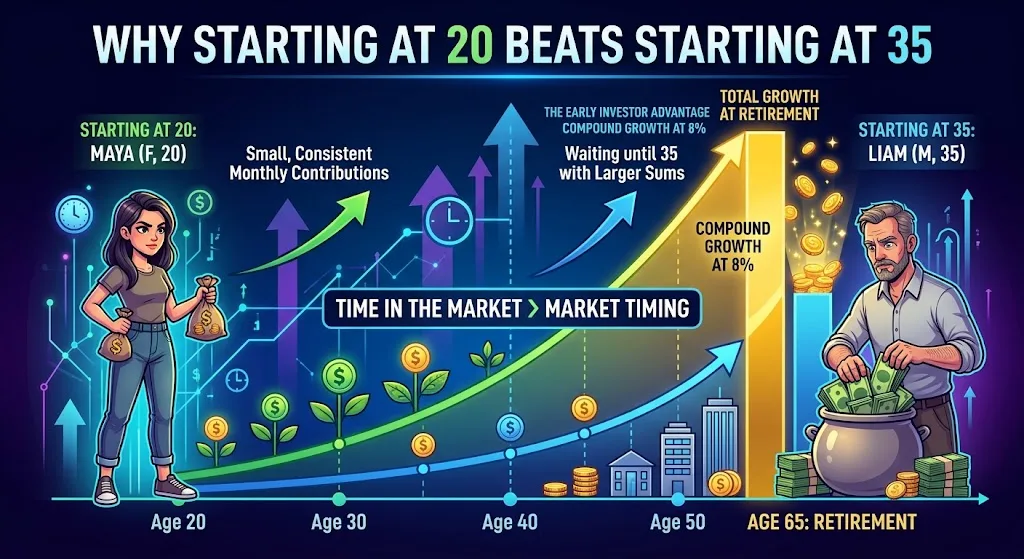
Why investing early is important comes down to compounding: when your investment returns generate their own returns over time. Starting at 16 gives your portfolio a compounding window that adults in their late 20s can never recover.
The Math of Starting at 16 vs. 26
Consider two investors, Maya and Alex, who both invest $150 per month into an S&P 500 index fund earning an average annual return of 8%.
Maya starts at age 16: She invests $150/month until age 65 (49 years). Her total out-of-pocket contribution is $88,200. At an 8% average return, her portfolio grows to approximately $1,023,000.
Alex starts at age 26: He invests $150/month until age 65 (39 years). His total out-of-pocket contribution is $70,200. At an 8% average return, his portfolio grows to approximately $442,000.
By starting ten years earlier, Maya puts in just $18,000 more of her own cash, but finishes with $581,000 more in total wealth due to compound growth.
Why Investing Early Matters More Than the Amount You Start With
Why investing early matters is less about the dollars you invest at 16 and more about building financial behaviors early.
Developing Risk Tolerance on Low Stakes: Losing 10% on a $200 portfolio at age 16 costs you $20 and teaches you how market volatility feels. Learning that same lesson at age 35 on a $200,000 portfolio costs $20,000.
Mistake Immunity: Buying a speculative stock that loses value at 16 provides an educational lesson while your living expenses (housing, food, utilities) are still covered by guardians.
Automated Consistency: Setting up a monthly transfer of $25 or $50 trains you to treat investing as a fixed expense rather than an afterthought.
How to Set Up Your First Account: Step-by-Step Walkthrough
Follow these steps to open a parent-supervised investing account cleanly:
Gather Required Documents: You and your parent will need legal names, dates of birth, Social Security Numbers (SSN), home address, and a linked US checking account.
Select the Right Platform: Choose Fidelity Youth Account if you want independent trade execution. Choose a Schwab UTMA if your parent wants to manage index funds for you without app fees. Choose Greenlight if your family wants strict per-trade parent approvals.
Parent Opens the Account: Your parent logs into their primary account (or creates one) and selects the teen or custodial option. They verify their identity through standard identity checks.
Teen Account Activation: Once approved, you download the app on your phone, accept the user terms, and create your separate login credentials.
Fund the Account and Buy Your First Asset: Transfer money into the account (e.g., $20). Place a fractional share order for a broad-market index ETF like an S&P 500 fund (e.g., VOO or SPLG) or a total market fund.
Common Pitfalls and Failure Modes to Avoid
1. App Shutdowns and Clearing Firm Lockups
Small niche fintech apps targeted at teens occasionally shut down or rebrand. When apps close (such as Flyte or EarlyBird in recent years), custodial funds are often held by back-end clearing houses like Apex Clearing. Extracting funds from a clearing firm after an app goes dark can take months of paperwork. Stick to established financial institutions (Fidelity, Schwab) or well-funded platforms to avoid clearing house friction.
2. The Kiddie Tax Surprise
UTMA and UGMA accounts belong to the minor, meaning unearned income (dividends, interest, and realized capital gains) is taxed under your name. Under IRS rules, unearned income above the annual threshold (around $2,600 for 2026) is taxed at the parent's marginal income tax rate rather than the teen's lower rate. Avoid excessive day trading in UTMA accounts to prevent unexpected tax bills for your parents.
3. Financial Aid (FAFSA) Impacts
Assets held directly in a student's name inside a UTMA/UGMA account are assessed at a 20% rate when calculating the Student Aid Index (SAI) for college financial aid. By contrast, assets held in a parent's name are assessed at a maximum of 5.64%. If college financial aid is a priority, holding funds in a parent-owned account or a 529 plan may be preferable to a large UTMA balance.
Internal and External Link Recommendations
custodial roth ira rules for working teens→ Link to your site's detailed guide on setting up teen retirement accounts.best low-cost index funds for beginners→ Link to your beginner portfolio allocation guide.how the kiddie tax works→ Link to your tax planning guide for family investments.
FINRA (Financial Industry Regulatory Authority): Citing youth investing guidelines and regulatory disclosures on custodial accounts.
Internal Revenue Service (IRS) Topic No. 553: Citing rules regarding tax on unearned income of dependent children (Kiddie Tax).
Consumer Financial Protection Bureau (CFPB): Citing educational frameworks for youth banking and financial capability.
Frequently Asked Questions
What investing apps can I use at 16?
At 16, you can use the Fidelity Youth Account to execute your own trades under parental supervision. You can also use custodial platforms like Greenlight, Bloom, or traditional UTMA/UGMA accounts at Charles Schwab and Interactive Brokers, where a parent manages or approves the account.
What investing apps can I use at 17?
At 17, you can use the Fidelity Youth Account, Greenlight, Bloom, and Schwab UTMA accounts. If you have earned income from a job, you can also have a parent open a Custodial Roth IRA for you, allowing you to invest up to $7,000 tax-free.
Can I buy stocks by myself at 16 without my parents?
No. Federal Know Your Customer (KYC) laws and contract laws require an adult to co-sign or manage brokerage accounts for anyone under 18. The Fidelity Youth Account comes closest by letting you trade independently, but your parent must still initiate and link the setup.
Can I buy Bitcoin on Coinbase at 16 if my parents allow it?
No. Coinbase, Kraken, and Binance enforce a strict 18+ age limit due to identity verification regulations. Attempting to sign up under age 18 will freeze your funds. Instead, you can invest in spot Bitcoin ETFs inside a custodial brokerage account.
Why is investing early important for teenagers?
Investing early is important because of compound returns. Starting at age 16 gives your money up to ten additional years to double compared to starting in your mid-twenties. Small monthly deposits made during your teenage years can grow significantly larger than bigger deposits started later in life.
Related articles: