Is the Bitcoin Four Year Cycle Dead? The Hard Truth About the 2026 Market Shift
Why the Traditional Halving Theory Failed in 2025 and What the "Supercycle" Means for Your Portfolio in 2026
Is the Bitcoin Four-Year Cycle Dead? The 2026 Market Template
In recent weeks, everyone has been asking the same question: Is the Bitcoin four-year cycle dead? Here's my honest answer: For the first time in crypto history, the data says yes. As of January 2026, the traditional "halving clock" has officially been broken. While the 2024 halving occurred on schedule, the post-halving bull run seems to have ended in October 2025.
In past cycles, we saw a strict "three years up, one year down" rhythm fueled by retail FOMO. However, this cycle seems different. The maturation of spot ETFs and the entry of sovereign-level buyers in 2025 created a "Left Translated Cycle"—front-running the supply shock and causing Bitcoin to peak months earlier than historical models predicted.
In this new phase, we are no longer trading against a four-year calendar; we are trading against global macro-liquidity. The 4-year cycle isn't just evolving; it has been replaced by a "Supercycle" where institutional floors prevent the 80% crashes of the past, and constant capital inflows create a permanent, non-seasonal bid.
So, if you're terrified that the bear market is about to bite, this article is your roadmap for the year ahead.
The "Left Translation" – What Happened in 2025?
To understand where we are going in 2026, we have to brutally analyze what just happened.
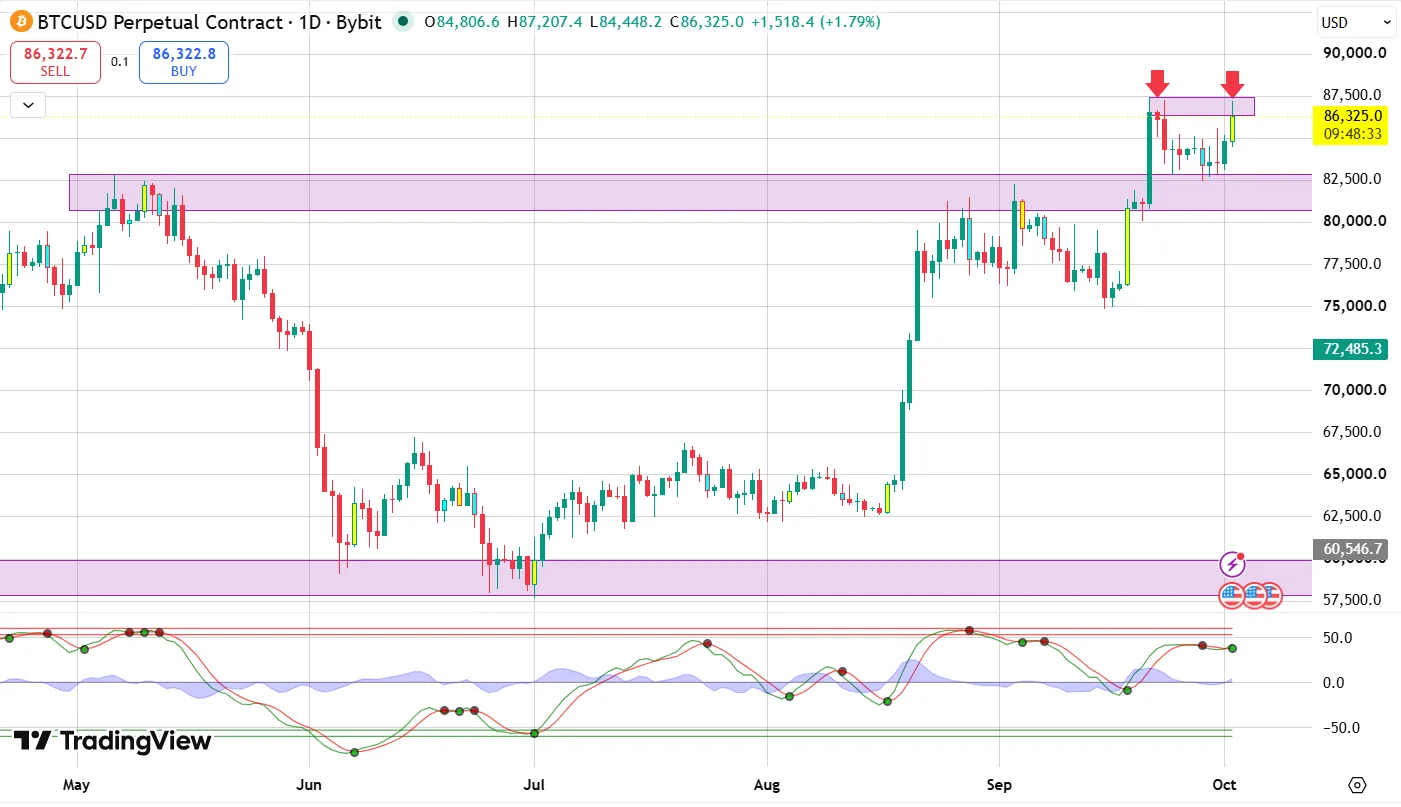
Historically, Bitcoin bull runs were supposed to extend longer each cycle. The 2013 run was fast; 2017 was longer; 2021 was a double-peak grind. Naturally, analysts predicted that the post-2024 Halving cycle would extend deep into 2026. They were wrong. See the sample chart below.
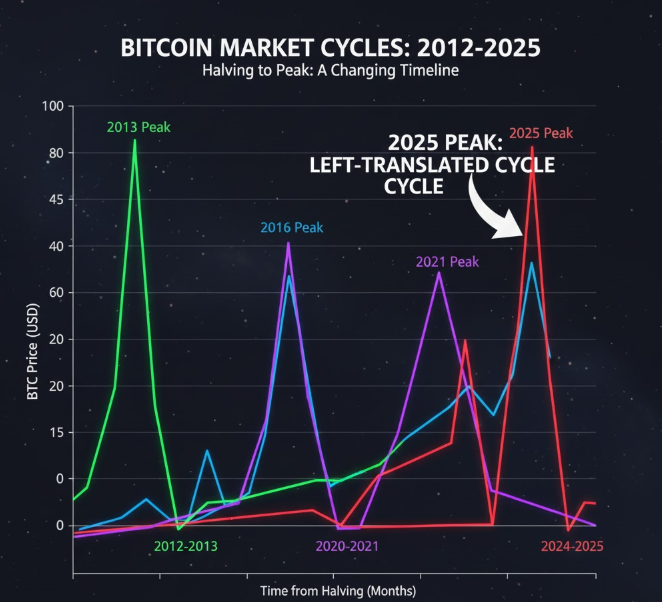
Instead, we got what technical analysts call a "Left Translated Cycle." In simple terms, the cycle accelerated. The price peaked earlier in the timeline than historical norms suggested, front-running the expectations of the masses. But why did Bitcoin peak early in 2025?
The answer lies in "Front-Running." In the age of information, everyone knew the 4-year cycle prophecy. Traders, hedge funds, and retail investors all tried to buy before the crowd. When everyone buys the rumor 6 months early, the top comes 6 months early.
This acceleration broke many of our favorite models. We have to be honest about the PlanB stock to flow model validity in this new era. While the model correctly identified the long-term upward trend, it struggled to pinpoint the volatility and timing of the 2025 top. Similarly, the Bitcoin lengthening cycle theory—which promised a peak in late 2026—appears to have been invalidated by the sheer speed of capital rotation in Q3 and Q4 of 2025.
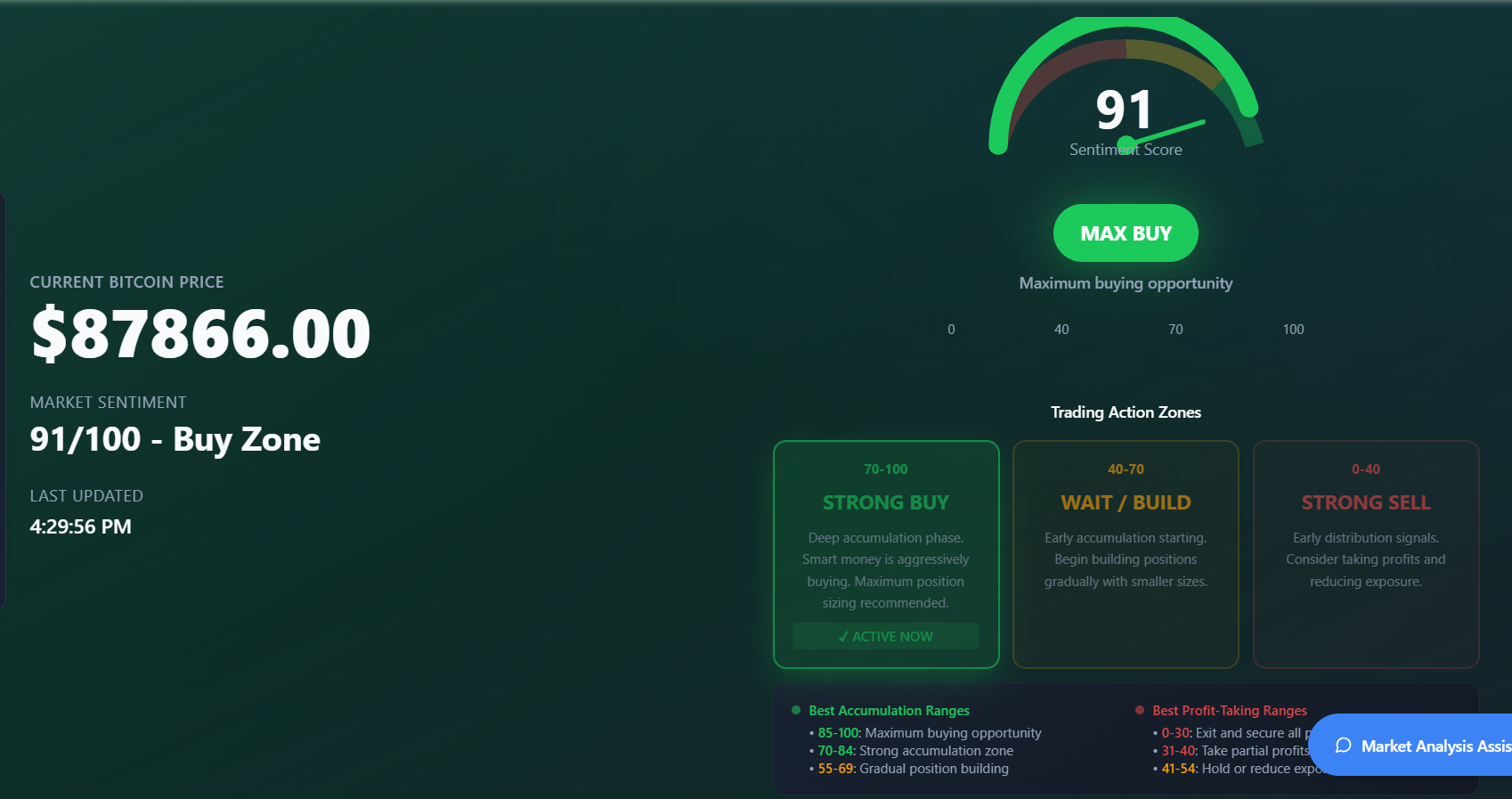
We are no longer in a slow grind; we are in a high-speed, high-frequency environment. Based on data from the Bitcoin Timing Model tool, we are in the final accumulation phase before the smart money investors resume selling.
The ETF Effect: How Wall Street Broke the Rhythm
If retail traders were the ones driving the bus in 2017 and 2021, Wall Street hijacked the steering wheel in 2025. This is the core argument for why the traditional cycle might be "dead."
The introduction and maturation of Spot Bitcoin ETFs created a "constant bid" that simply didn't exist before. In previous cycles, price was driven by retail mania—waves of FOMO followed by crushing despair. Retail traders operate on a 4-year memory. Institutions, however, operate on quarterly rebalancing schedules.
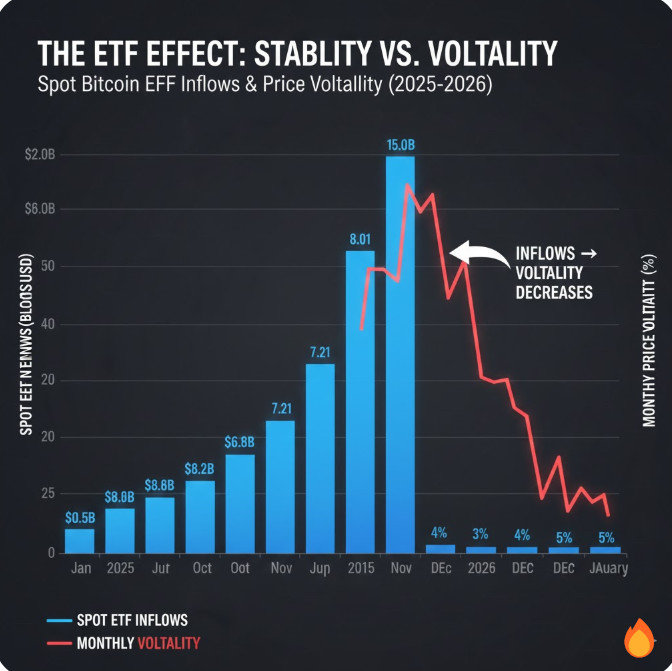
This structural shift has a profound Spot Bitcoin ETF long-term effect. The massive passive inflows from pension funds and RIAs (Registered Investment Advisors) dampen the volatility. They buy when the price dips 10% to rebalance their portfolios, preventing the 40% crashes we used to see on a Tuesday. Conversely, they sell into strength to maintain their allocation percentages, capping the "God Candle" spikes.
We are also seeing the institutional adoption impact on Bitcoin volatility play out in real-time. The market is becoming more efficient, but also more correlated with global liquidity rather than just the Halving code.
But the wildest card for 2026 isn't BlackRock; it's the nations. Throughout 2025, we heard whispers of sovereign Bitcoin adoption in 2026. Smaller nations, watching El Salvador's success, have begun accumulating BTC for their treasuries. When a Nation-State buys, they don't day trade. They lock supply away for decades. This is how institutions are breaking the Bitcoin cycle—by removing coins from circulation permanently, regardless of where we are in the "4-year" calendar.
The Counter-Argument: The Mathematics of Supply
Before we declare the cycle completely dead, let’s look at the math. The cycle might not be dead; it might just be muted.
The Halving is hard-coded physics. You cannot argue with the post-halving supply shock mechanics. The issuance of new Bitcoin was cut in half in 2024, and the supply squeeze is real. However, we are battling the law of large numbers.
It takes significantly more capital to move Bitcoin from $100k to $200k than it took to move it from $1k to $2k. We are facing Bitcoin diminishing returns in 2026. The days of 100x returns in a single year for Bitcoin are likely over. We are trading volatility for stability.
This suggests a crypto market structure change. Bitcoin is behaving less like a tech stock and more like digital gold. In previous years, Bitcoin moved in lockstep with the Nasdaq. If the QQQ tanked, BTC tanked. But late 2025 showed us the first real signs of Bitcoin decoupling from stock market weakness. As fiat currencies wobbled, Bitcoin held its ground; not because of a hype cycle, but because of its monetary properties.
So, the "cycle" isn't dead, but the magnitude of the cycle is dying. We are transitioning from "Crypto Casino" to "Global Reserve Asset."
The 2026 Outlook: Bear Market or Supercycle?
So, here we are in 2026. What comes next? The fear in the market is palpable: newbie investors are asking, Will Bitcoin crash in 2026?
Because of the ETF floor and institutional accumulation, an 80% drawdown is statistically unlikely. Instead, we are likely entering the "Supercycle." A Supercycle is defined not by a parabolic blow-off top followed by a crash, but by a longer, slower grind upward with shallow corrections of 20-30%.
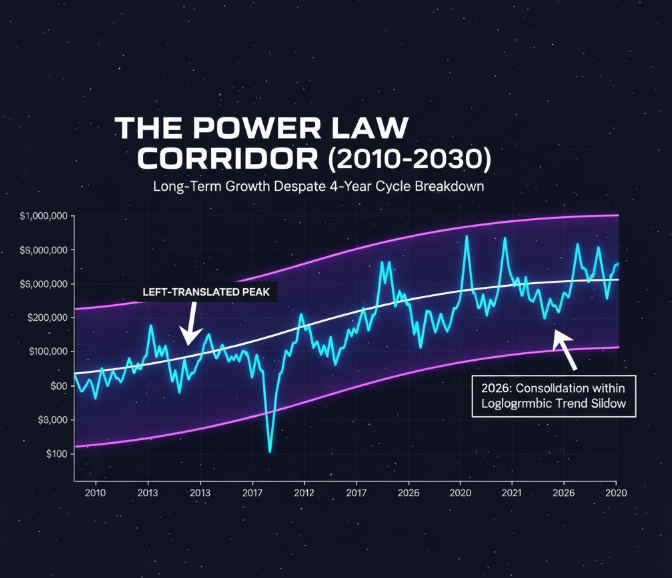
To fully understand this, stop looking at the Rainbow Chart and start looking at the Bitcoin power law corridor 2026. The Power Law models Bitcoin's growth as a function of time and adoption, smoothing out the bubbles. It predicts that while we may be "overheated" right now, the floor keeps rising.
Next Bitcoin bear market prediction? In my view, it won't be a crash; it will be a "time correction." Price may fluctuate sideways for 8 months, boring retail traders to death, while institutions quietly scoop up the supply. In this phase, boredom, not pain, is the new enemy.
Conclusion: Adapting to the New Era
The 4-year cycle isn't dead, but relying on it exclusively is financial suicide. If you are waiting for a specific date on the calendar to sell everything, you are playing a game that Wall Street has already rigged.
We have entered a new era. The volatility is dampening, the players are bigger, and the timeline is blurring. Call to Action: Don't navigate 2026 blind. Subscribe to the Crypto Beast newsletter below. We focus on market structure and on-chain data, not just calendar dates.
The final thought for 2026? It's no longer about "Time"; it's about "Liquidity." Stay sharp.
Thanks for reading.
P.S. Need More Help and Resources?
Buy and sell crypto on Bybit, my preferred crypto exchange.
Download the Crypto Traders’ Handbook
Download Your AltSeason Blueprint
Upgrade Your Subscription to receive a copy of the BTM user’s guide.
Now, here are a few frequently asked questions we gathered in our survey:
FAQ: Quick Answers for the New Year
Is the Bitcoin bear market cancelled? No, it's not cancelled, but redefined. The days of -85% crashes are likely over due to institutional capital floors. So, expect shallow corrections (-30%) and long periods of sideways consolidation instead.
What is the Bitcoin price prediction 2026-2030? Well, most conservative models place Bitcoin in the $150k–$250k range by 2026, driven by scarcity. And bullish "Supercycle" models suggest a run toward $500k by 2030 as it eats into Gold's market cap.
What do you think about this topic? Do you think the Bitcoin four-year cycle is broken? Share your thoughts in the comments.
Download the Crypto Traders’ Handbook
Download Your AltSeason Blueprint