Will Bitcoin Bounce Back Up in 2026? The Recovery Roadmap for Smart Investors
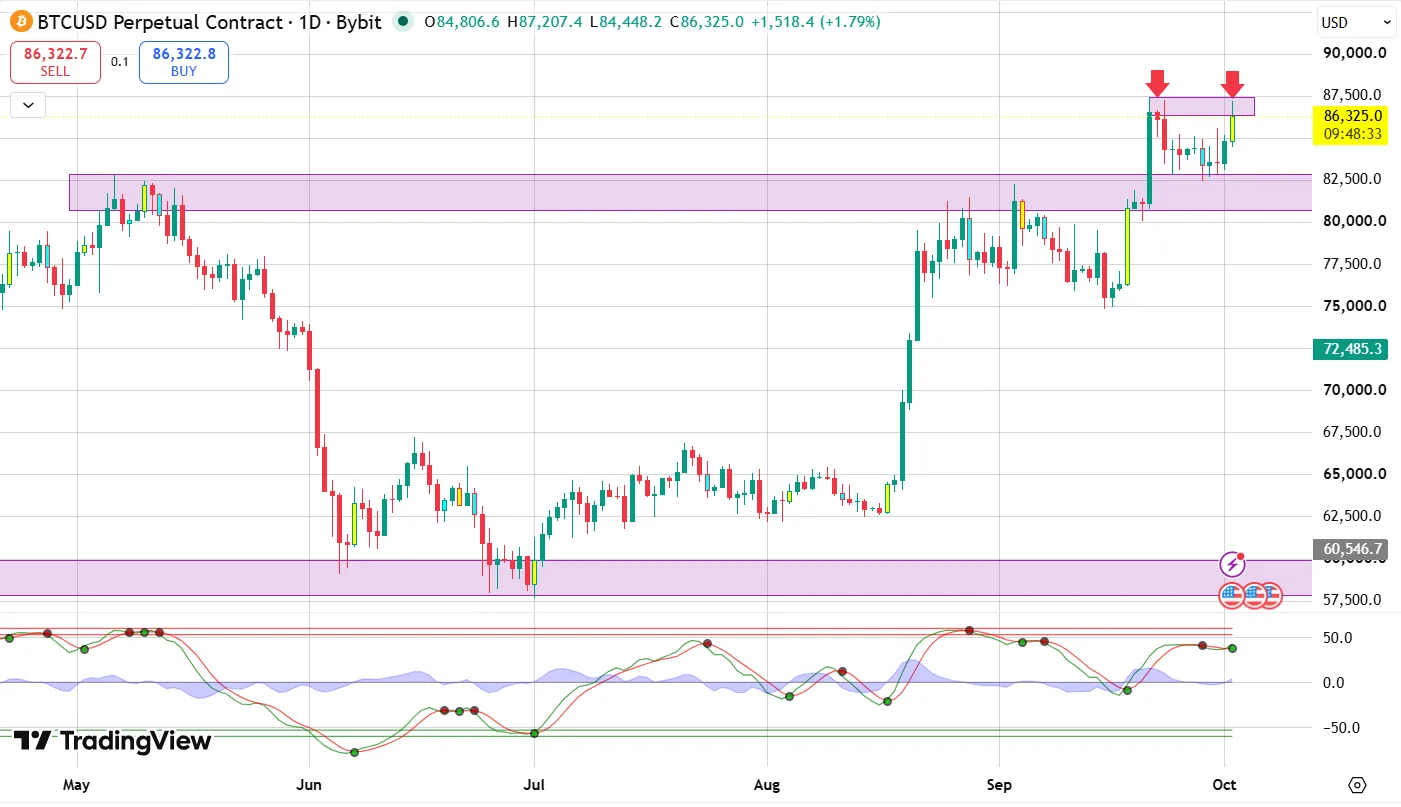
After the liquidations that shook the market last month, investors are asking: Will Bitcoin bounce back up in 2026? The consensus among analysts at Standard Chartered, Bernstein, and Grayscale is a definitive yes. The recovery is driven by a "Liquidity Vacuum" on exchanges and a pivot in Fed policy. Read the full article for details.
Will Bitcoin Bounce Back Up in 2026?
In recent weeks, the search for "Will Bitcoin Bounce up in 2026" has been explosive, and here is my definitive answer: Yes—Bitcoin is structurally positioned for a strong recovery in 2026. While the "mechanical" liquidations of late 2025 caused a painful 36% drawdown from the $126,000 peak, the underlying market condition has never been stronger.
So far, we are witnessing the "January Effect" in real-time as institutional buyers absorb the $88,000 dip. This isn't just a dead-cat bounce; it is a fundamental shift fueled by a triple-threat of catalysts: aggressive Fed rate cuts injecting fresh liquidity, the passage of the CLARITY Act providing a legal green light for corporate treasuries, and a supply vacuum on exchanges at levels not seen since 2018.
In my view, the "four-year cycle" may be dead, but the Bitcoin Supercycle is just entering its second act, with institutional price targets firmly clustered between $150,000 and $175,000 for the first half of the year.
So, if you are wondering if the 2025 Bitcoin correction is over, let’s dive deep into this analysis for the year ahead.
The Macro Engine – Why Liquidity Is the Key Catalyst
As already established, Bitcoin doesn't live in a vacuum; it breathes the air of global liquidity. Now, as we move into Q1 2026, the "Macro Engine" is starting to rev up.
The biggest tailwind is the "Fed" Factor. And markets are currently pricing in 75–100 basis point rate cuts throughout 2026. This shift is monumental because lower interest rates drastically reduce the "opportunity cost" of holding non-yielding assets like Bitcoin. And when T-bills pay less, the orange coin looks a lot more attractive.
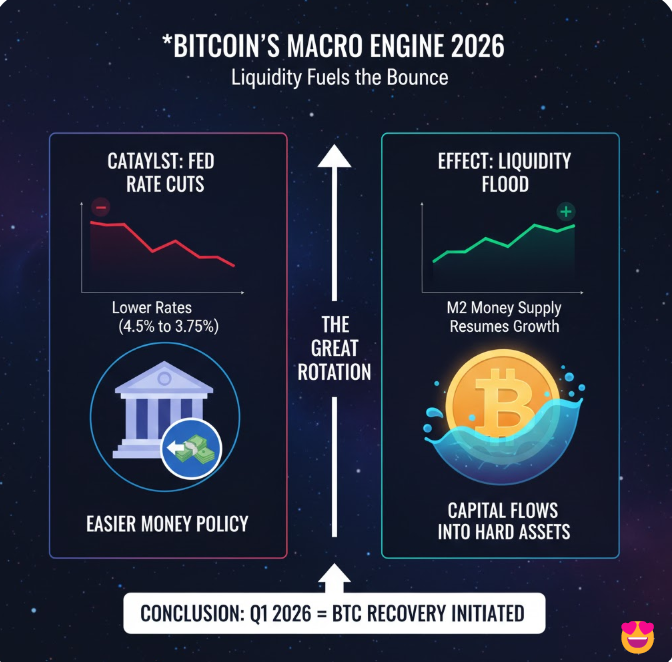
Furthermore, we are witnessing a global M2 money supply expansion. As central banks return to a "growth at all costs" posture, hard-capped assets stand to benefit the most. One of the primary macroeconomic catalysts for crypto recovery is the stark divergence we saw last year: while Gold surged 60%, Bitcoin remained relatively flat. This suggests a massive "catch-up" trade is looming, solidifying Bitcoin as digital gold in 2026.
But the question is, will central bank liquidity drive Bitcoin higher? Historically, when the Fed's interest rate cuts impact on Bitcoin, the bounce is usually swift and violent. Hence, we expect a massive recovery for Bitcoin and altcoins in Q1 2026 before another major correction.
The Institutional Floor – Who is Buying the $90,000 Dip?
While retail investors are fearful, the "Big Money" is quietly setting a floor. Many feared that the Spot Bitcoin ETF net inflows in 2026 would dry up after the December volatility, but the data tells a different story. Inflows slowed, yes, but we didn't see the mass exodus many predicted.
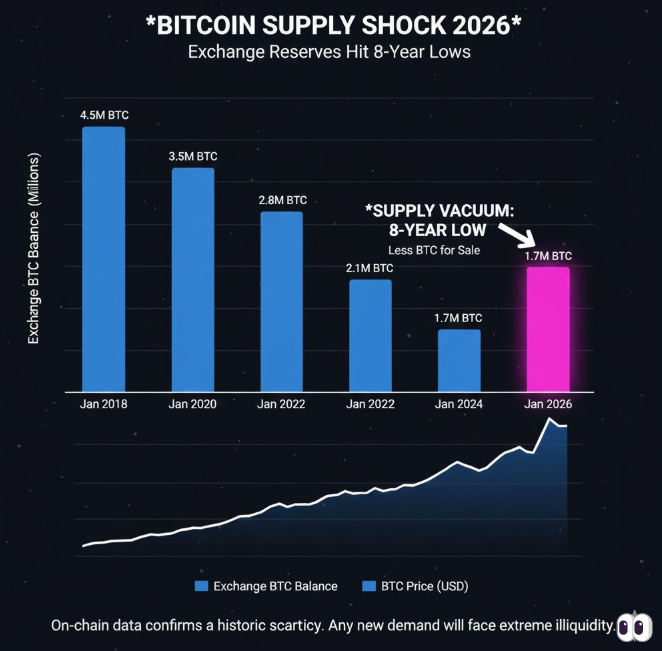
The "Institutional Floor" is being built by corporate giants. Companies like MicroStrategy, and the 170+ other public firms now holding over 1 million BTC collectively, represent a "permanent bid." Remember, they aren't trading the 4-year cycle; they are breaking it. See the BTC supply short chart below.
Moreover, the anticipated Digital Asset Market Clarity Act is expected to be signed into law this quarter. This legislation is projected to unlock an estimated $15 billion in previously sidelined institutional capital. Between institutional capital inflows in 2026 and evolving corporate treasury Bitcoin adoption trends, the "dip" at $90k is being aggressively absorbed by the world’s most sophisticated balance sheets. In simple terms, it means that whales and smart money are buying.
Technical Analysis – Finding the 2026 Floor
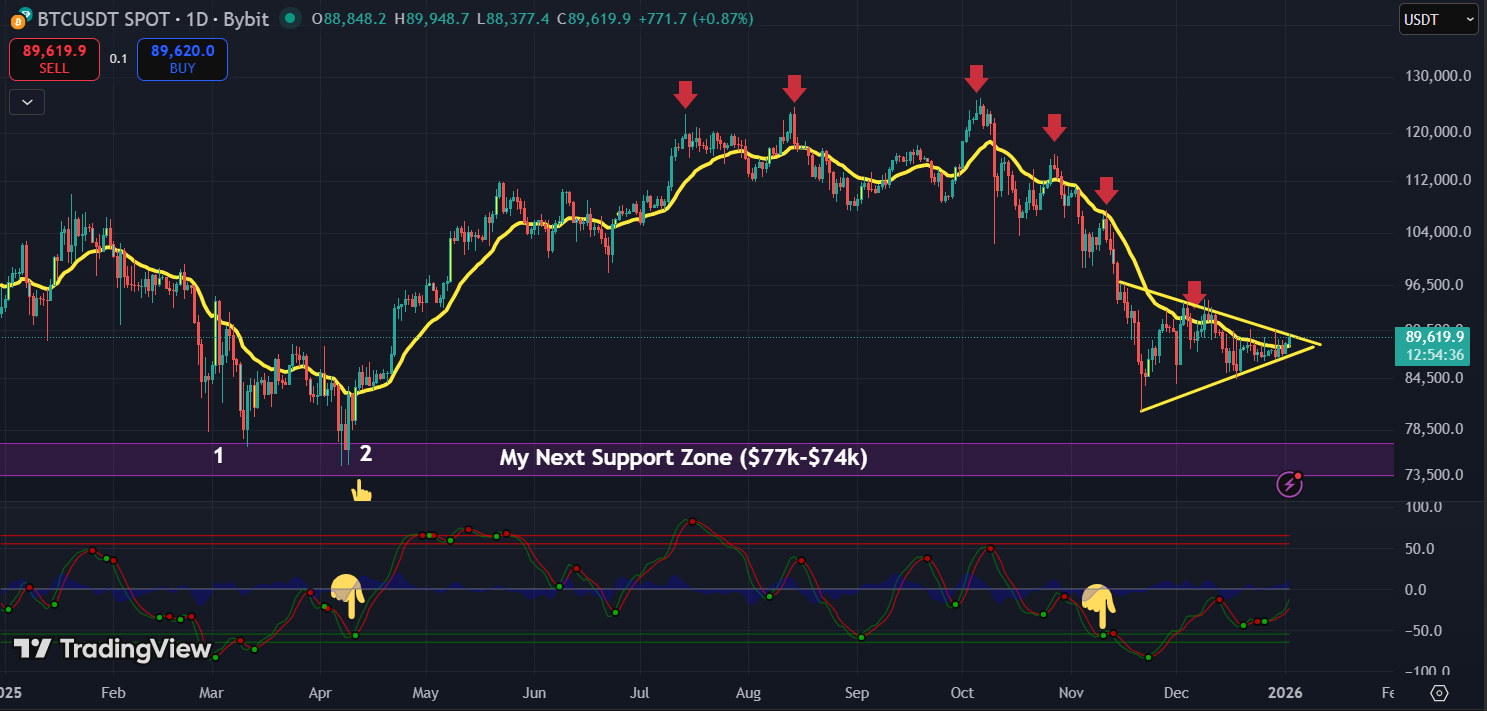
From a technical perspective, the Bitcoin price recovery forecast for 2026 hinges on a very specific range.
Currently, we have established a critical demand zone between $84,000 and $86,000. We are currently coiling inside a "stalemate triangle" that is squeezing toward the $92,000 resistance level. Once we break $92k with volume, the path to the Bitcoin price prediction $150k—a target shared by Standard Chartered and JPMorgan—becomes much clearer. See the chart below.
What makes this recovery different is the liquidity vacuum. From our on-chain data, exchange reserves are currently at 2018 lows. This means there is very little "sell-side" supply available. And when demand returns, there will be no coins left to buy, likely causing a vertical price spike. So, if you are asking, "Is Bitcoin undervalued at $90,000?" the answer is yes, and the reason lies in the supply/demand mismatch.
The 2026 Narrative Shift – Sovereign Adoption & AI
Beyond the charts, two massive narratives are shifting.
First, the "Nation-State Game Theory" is entering a new phase. Rumors are swirling that several European and Asian countries are moving from "research" to "accumulation," evaluating sovereign BTC holdings to hedge against fiat debasement. This sovereign adoption affecting Bitcoin recovery creates a type of demand that retail cycles can't account for.
Second, the "AI Pivot" is changing the mining landscape. Major miners are shifting their excess power to AI compute, providing them with a "stability layer" of non-volatile revenue. This makes the network more resilient than ever. As we see Bitcoin decoupling from Nasdaq 100 volatility, the Bitcoin vs Gold performance 2026 battle will be the one to watch.
Conclusion: The "Slow Bull" Era
In summary, 2026 won't be a 2017-style "moon mission" filled with 100x shitcoins. Instead, it will be a structural, institutional grind higher. We are no longer slaves to the 4-year cycle; we are living the Bitcoin supercycle theory 2026.
The market is maturing, and the "mechanical washouts" are simply part of the process of moving coins from weak hands to strong ones.
Don't let the noise shake you. If you want to stay ahead of the curve, upgrade your subscription to receive signals for weekly on-chain updates and deep-dive liquidity analysis.
FAQ: The 2026 Quick-Start Guide
Q: Why did Bitcoin drop in late 2025? The drop was primarily driven by "mechanical liquidations." Over $19 billion in leveraged positions were flushed out alongside institutional year-end de-risking as funds locked in gains for their annual reports.
Q: When will the next bull run start? Most analysts, including those at Grayscale and Citi, predict that the next crypto bull run start date in 2026 will be in H1, as the "Institutional Era" fully takes hold and the new regulatory clarity takes effect. But I feel 2026-2027 will be a sideways market for Bitcoin. So, I urge everyone in my community to reduce exposure whenever Bitcoin retests the $115,000 to $120,000 region.
Thanks for reading.
P.S. Need More Help and Resources?
Buy and sell crypto on Bybit, my preferred crypto exchange.
Download the Crypto Traders’ Handbook
Download Your AltSeason Blueprint
Upgrade Your Subscription to receive a copy of the BTM user’s guide.