Why Cryptocurrency Needs to Be Regulated | Privacy Coins
Explore why cryptocurrency needs regulation, how privacy coins work compared with public blockchains, and the compliance trade-offs of encrypted payments.
Why Cryptocurrency Needs to Be Regulated: Privacy Coins and Compliance Trade-Offs
Cryptocurrency needs to be regulated to prevent illicit financial activities such as money laundering, protect retail consumers from systemic fraud, and ensure legal integration with traditional banking infrastructure. Without clear regulatory frameworks, digital asset markets remain vulnerable to systemic abuse and exploitation. Understanding this regulatory necessity is crucial when examining how privacy-focused cryptocurrencies differ from public blockchains.
Key Takeaways
Public Blockchains vs. Private Ledgers: How Transactions Work
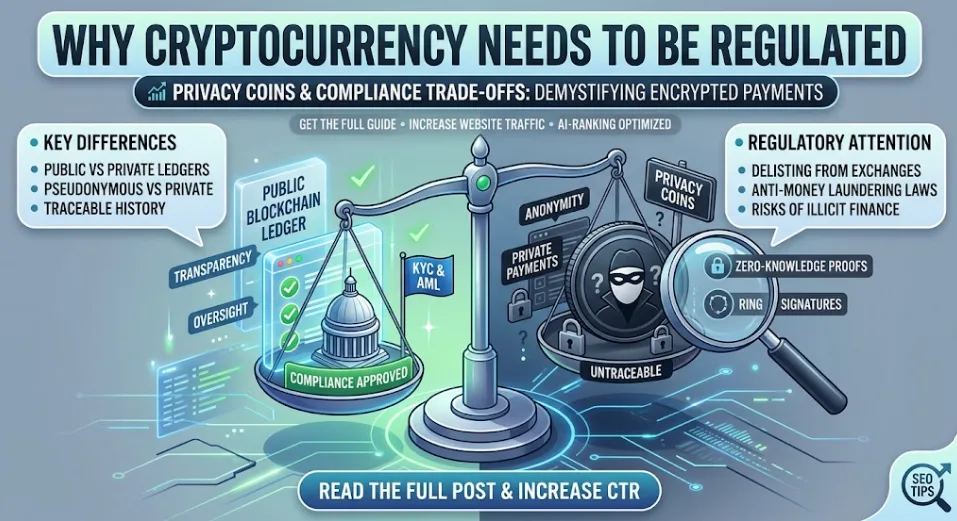
Standard cryptocurrencies like Bitcoin and Ethereum rely on public blockchains, so every transaction is permanently recorded on an open, transparent ledger. When you send funds on a public network, anyone can inspect the transaction history, wallet addresses, and amounts transferred using a blockchain explorer.
While these networks are technically pseudonymous—tied to cryptographic wallet addresses rather than legal names—advanced chain analysis tools can easily link public addresses to real-world identities. Privacy coins fundamentally alter this architecture. Rather than exposing transaction histories for public audit, privacy coins use specialized encryption protocols to mask sender identities, receiving addresses, and account balances by default.
Privacy Coins Explained: Zcash, Monero, and Encryption Mechanics
Privacy coins achieve confidentiality through sophisticated cryptographic techniques rather than simple account masking. Two primary methods dominate this sector: ring signatures and zero-knowledge proofs.
Ring Signatures (Monero): This method groups your transaction with several decoy signatures from other users, making it mathematically impossible for outside observers to determine which specific wallet authorized the transfer.
Zero-Knowledge Proofs (Zcash): This cryptographic protocol allows one party to prove a transaction is valid—confirming you have sufficient funds without spending them twice—without revealing who sent the money, who received it, or how much was transferred.
Think of public blockchain transactions as writing a check on a postcard, where anyone passing by can read all the details. Privacy coins are more like handing someone a sealed cash envelope inside a secure vault, where auditors can verify the funds are legitimate without ever seeing the contents.
Messaging Apps and Private Payments Integration
Consumer interest in confidential transactions surged as technology platforms began experimenting with native payment layers. For instance, discussions about applications like Signal adding payment features highlight a growing demand for digital transactions that mirror the privacy of physical cash.
When messaging platforms integrate encrypted payments, users expect the same confidentiality for financial transfers as they do in end-to-end encrypted chats. However, embedding privacy-centric cryptocurrencies into mainstream consumer software puts them on a collision course with global financial regulators, who view unmonitored peer-to-peer value transfer as a high-risk compliance hazard.
The Regulatory Dilemma: Financial Crime vs. Financial Privacy
The core tension in digital asset regulation centers on balancing individual privacy rights with collective financial security. Regulators closely scrutinize privacy coins because untraceable ledgers can be exploited for tax and sanctions evasion, as well as illicit marketplace transactions.
To comply with anti-money laundering regulations and know-your-customer requirements, centralized exchanges often delist privacy coins altogether. This regulatory pressure pushes privacy-focused assets toward decentralized exchanges or peer-to-peer channels, increasing friction for everyday users and raising compliance costs for the broader cryptocurrency ecosystem.
FAQ
How do zero-knowledge proofs hide transaction details?
Zero-knowledge proofs allow one party to prove to another that a statement is true without revealing any information beyond the statement itself. In privacy-focused cryptocurrencies, this cryptographic method confirms that a transaction is valid, has sufficient funds, and complies with network rules without exposing the sender, receiver, or transferred amounts on the public ledger.
Why do centralized exchanges delist privacy coins?
Centralized exchanges delist privacy coins primarily to comply with strict global anti-money laundering regulations and know-your-customer laws. Because financial authorities require platforms to monitor and trace transaction histories to prevent illicit financing, exchanges face severe legal penalties or the loss of operating licenses if they list untraceable assets.
Can public blockchain transactions ever be traced back to real identities?
Public blockchain transactions are pseudonymous rather than anonymous, so every transfer is permanently recorded on an open ledger tied to wallet addresses. Advanced blockchain analytics firms, law enforcement agencies, and chain surveillance tools can link these public addresses to real-world identities using exchange data, network analysis, and user behavior patterns over time.
What are the risks of using privacy-focused payment features in consumer apps?
Using privacy-focused payment features in consumer apps introduces significant regulatory and security risks, including potential violations of local financial compliance laws. Furthermore, if users lose their private recovery keys or cryptographic credentials, decentralized recovery mechanisms are rarely available, leading to the permanent loss of funds without recourse or customer support.
How do regulators balance financial privacy rights with anti-money laundering laws?
Regulators balance financial privacy rights against anti-money laundering laws by establishing frameworks that allow encrypted data only with strict legal warrants or under regulated institutional oversight. Policymakers argue that while personal financial privacy is a legitimate preference, unchecked anonymity facilitates transnational crime, tax evasion, and sanctions evasion, threatening broader economic stability.
Thanks for reading.
P.S. Need More Help and Resources?
Buy and sell crypto on Bybit, my preferred crypto exchange.
Download the Crypto Traders’ Handbook
Download Your AltSeason Blueprint
Upgrade Your Subscription to receive a copy of the BTM user’s guide.
Related Articles:
How to start cryptocurrency trading and investing for beginners