What Cryptocurrency Does Elon Musk Own? Disclosed Holdings & Risks
Learn what cryptocurrencies Elon Musk and Donald Trump hold based on public filings, and explore the liquidity risks of copy-trading public figures.
What Cryptocurrency Does Elon Musk Own? Holdings and Retail Copy-Trading Risks
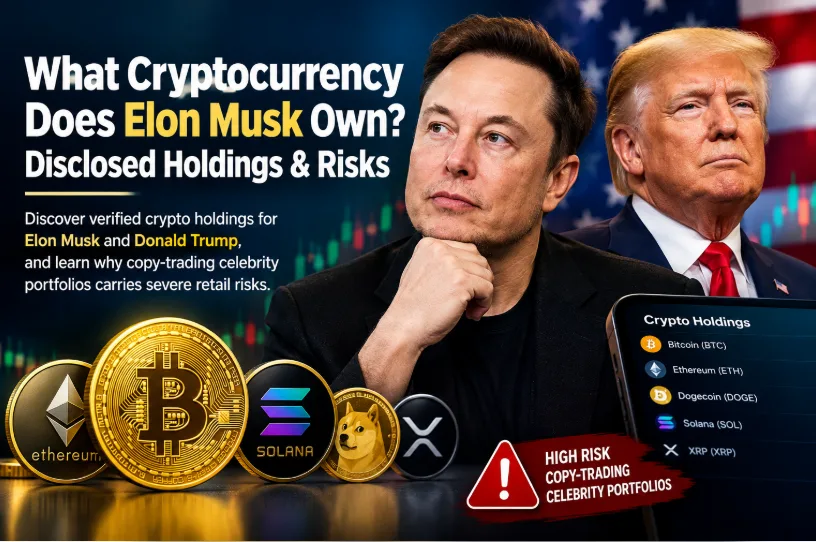
Elon Musk has publicly confirmed that he personally owns three cryptocurrencies: Bitcoin (BTC), Ethereum (ETH), and Dogecoin (DOGE). At The B Word conference, Musk stated that Bitcoin is his largest personal cryptocurrency holding outside his equity positions, followed by Ethereum and Dogecoin. His companies, Tesla and SpaceX, also hold substantial Bitcoin balance sheet reserves, and Tesla accepts Dogecoin for select merchandise purchases.
While high-profile portfolio disclosures generate significant public curiosity, replicating celebrity or politician portfolios poses severe market risks for retail investors. Public disclosures reflect past actions rather than real-time strategies, and high-net-worth positions often include liquidity advantages, lock-up terms, or hedging strategies that retail investors cannot replicate.
Key Takeaways
Elon Musk’s Disclosed Crypto Holdings
Elon Musk’s relationship with digital assets spans both personal holdings and corporate balance sheets. Across multiple public statements and financial disclosures, his cryptocurrency involvement breaks down into specific assets:
Bitcoin (BTC): Musk’s largest personal digital asset holding. Additionally, corporate filings show that Tesla retains more than $1 billion in Bitcoin as part of its liquid balance sheet. SpaceX also maintains significant corporate Bitcoin reserves.
Ethereum (ETH): Held personally as a secondary layer-1 allocation alongside Bitcoin.
Dogecoin (DOGE): Musk’s most publicly championed meme coin. Beyond personal ownership, Dogecoin is accepted as payment for select Tesla merchandise and SpaceX project funding.
Important Note: Musk has repeatedly clarified that neither he nor his companies endorse third-party tokens using his name or likeness. Unofficial "Musk-themed" tokens carry extreme speculative risk and are completely unaffiliated with his operations.
Donald Trump’s Disclosed Crypto Portfolio
For those asking which cryptocurrency Donald Trump invested in or owns, public financial disclosures filed with government ethics offices provide clear line items. Donald Trump's crypto portfolio spans liquid digital assets, licensing revenues, and governance of decentralized finance (DeFi) projects:
Ethereum (ETH) & Wrapped ETH (WETH): Public wallet tracking and financial disclosures indicate holdings derived from royalty income generated by official NFT licensing collections.
World Liberty Financial (WLFI): Associated with a family-backed decentralized finance initiative, with disclosures detailing allocations of governance tokens and revenue-sharing mechanisms tied to stablecoin and lending protocol operations.
Digital Collectibles / Royalty Rights: Holdings derived from licensing agreements for digital trading card collections, primarily denominated in cryptocurrency or stablecoins.
Comparing Disclosed Holdings & Market Structure
Public figures acquire and manage cryptocurrency under market mechanics that differ significantly from those of retail exchanges. The structural differences between personal retail holdings and high-profile entity allocations are outlined below:
Liquidity Disparities & Downside Risks for Retail Buyers
Blindly purchasing assets because a public figure holds them introduces major structural disadvantages.
1. Information Asymmetry and Delayed Disclosures
When public figures' portfolios become public knowledge—whether through ethics forms, SEC filings, or media reports—the market has already priced in that information. Buying based on periodic disclosures means entering a position weeks or months after the initial transaction.
2. Order Book Liquidity and Slippage
Prominent figures execute large-volume transactions via Over-the-Counter (OTC) desks to minimize market impact. Retail traders attempting to execute market orders during sentiment spikes experience high slippage, buying at inflated prices before order books rebalance.
3. Asymmetric Downside Risk
A $10 million position in an altcoin is a fraction of a percent of a billionaire's overall wealth. If that token drops 90%, the loss has no impact on their financial solvency. For a retail investor deploying a substantial portion of their savings, that same 90% drawdown represents catastrophic capital destruction.
A Risk Management Framework for Beginners
Rather than copying celebrity portfolios, beginners should establish basic operational and analytical parameters:
Focus on Fundamental Utility: Evaluate projects based on real-world usage, active developer communities, transaction throughput, and economic sustainability rather than on high-profile endorsements.
Understand Market Capitalization & Liquidity: Verify that an asset has sufficient 24-hour volume on depth-heavy exchanges to allow entry and exit without severe slippage.
Practice Capital Allocation Principles: Limit single-asset speculative exposure to a manageable percentage of your liquid net worth.
Distinguish Assets from Holdings: Differentiate between spot token purchases, venture equity, protocol governance rights, and promotional licensing fees.
Frequently Asked Questions
Does Elon Musk own Shiba Inu or other meme coins?
No. Elon Musk has explicitly confirmed that he does not own Shiba Inu (SHIB) or any other meme tokens except Dogecoin. He has stated on several occasions that his personal digital asset holdings are strictly limited to Bitcoin, Ethereum, and Dogecoin.
How do government financial disclosures track politicians' crypto holdings?
In the United States, public officials file periodic financial disclosures (such as OGE Form 278e) that list broad value ranges for assets held during the reporting period. These forms disclose holdings above specific valuation thresholds but do not provide real-time transaction tracking or precise wallet addresses.
Can celebrity tweets legally move crypto markets?
High-profile social media posts often trigger short-term volatility, especially in low-liquidity altcoins or meme tokens. However, price spikes driven by social media posts are typically short-lived, with prices quickly reverting as automated algorithms and market makers absorb the order flow.
What is the safest way for beginners to start investing in crypto?
Beginners should start with foundational assets like Bitcoin and Ethereum, use reputable centralized exchanges with strong security standards, enable multi-factor authentication, and avoid over-leveraging capital or copying speculative social media trends.
Thanks for reading.
P.S. Need More Help and Resources?
Buy and sell crypto on Bybit, my preferred crypto exchange.
Download the Crypto Traders’ Handbook
Download Your AltSeason Blueprint
Upgrade Your Subscription to receive a copy of the BTM user’s guide.
Related Articles:
How to start cryptocurrency trading and investing for beginners
Understanding key differences between Bitcoin and Cryptocurrency