Cryptocurrency Investment Due Diligence Guide (2026)
Learn how to start cryptocurrency investment research using a 4-step due diligence scorecard. Evaluate tokenomics, code commits, and utility before buying in 2026.
Cryptocurrency Investment Due Diligence: A 4-Step Research Scorecard for 2026
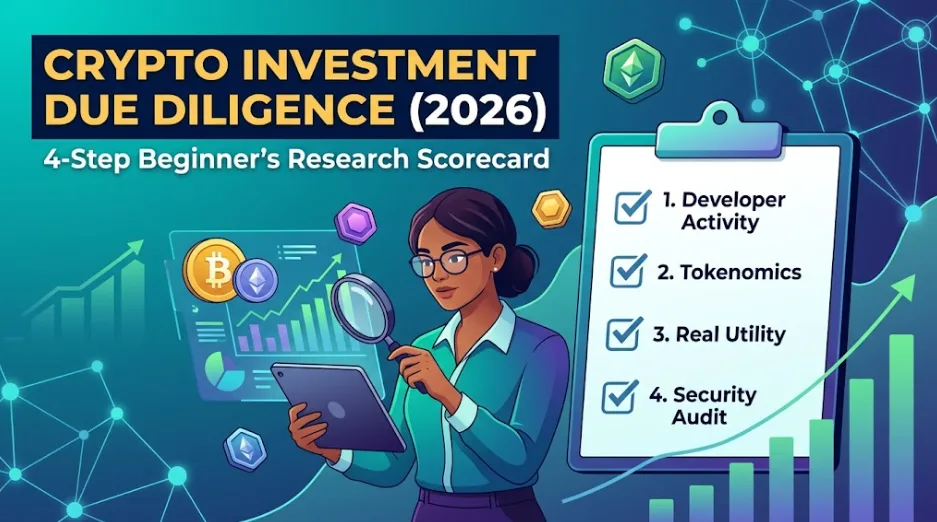
To execute a sound cryptocurrency investment strategy, you must evaluate digital assets using objective fundamental data rather than social media sentiment or influencer endorsements. A structured due diligence process should assess GitHub developer commits, token release schedules, actual protocol revenues, and smart contract security. By applying a repeatable four-part scorecard, you can filter out predatory token designs and identify projects with sustainable utility. Now, let's get started!
Key Takeaways
GitHub developer activity reveals whether a blockchain project is actively maintained or functional vaporware.
Tokenomics analysis protects investors from severe price dilution caused by sudden team or insider token unlocks.
On-chain revenue and daily active wallet metrics distinguish functioning Web3 services from purely speculative tokens.
Independent smart contract audits and decentralized governance reduce exposure to exploits and rug pulls.
Step 1: Evaluate Active Developer Activity and Code Quality
A cryptocurrency project is ultimately software. If developers stop maintaining the codebase, the network cannot innovate, patch vulnerabilities, or adapt to evolving industry standards.
Begin your research in public repositories such as GitHub or GitLab. Look beyond the main repository starred by casual users and inspect the core development branches.
Commit Frequency: Check if engineers commit code weekly across multiple repositories, or if activity halted months ago.
Developer Count: Count the number of active, non-bot contributors over the last 90 days using public tools like Token Terminal or Developer Report.
Peer Reviews: Review pull requests to confirm that code changes undergo peer review and testing before merging to main branches.
Step 2: Audit Tokenomics, Supply Caps, and Unlock Schedules
Tokenomics determines how token supply and demand affect long-term asset prices. A project with strong technology will still experience severe price depreciation if market supply inflates rapidly.
Locate the protocol's whitepaper, documentation, or analytics dashboards such as CoinMarketCap or DefiLlama to verify these critical supply metrics:
Circulating vs. Maximum Supply: High ratios of fully diluted valuation (FDV) to market cap indicate significant future inflation.
Vesting Schedules: Identify when early seed investors, team members, and advisors receive unlockable tokens. Large unlocks frequently cause selling pressure.
Token Utility: Verify if the token serves a structural function, such as paying gas fees, securing consensus, or capturing protocol yield.
Step 3: Assess Real Protocol Utility, Revenue, and User Metrics
Promotional announcements do not equate to user adoption. In 2026, assessing which cryptocurrency assets offer sustainable value requires examining verified on-chain metrics.
Focus on data that demonstrates actual usage rather than wash-trading volume or incentivized yield farming.
Daily Active Addresses: Look for steady or growing unique daily transacting wallets over a 180-day window.
Protocol Fees and Revenue: Measure how much total revenue the protocol generates from actual usage fees versus how much it pays out in token emissions.
Total Value Locked (TVL): For decentralized finance protocols, review TVL alongside protocol revenue to confirm capital efficiency.
Step 4: Verify Smart Contract Security and Decentralization
Unsecured code exposes your capital to total loss from exploits, flash loan attacks, or administrative backdoors. Every legitimate protocol must submit its smart contracts for third-party security audits.
Audit Reports: Confirm that reputable security firms (such as OpenZeppelin, Trail of Bits, or CertiK) audited the exact contracts currently deployed on-chain.
Bug Bounties: Check if the team hosts an active bug bounty program on platforms like Immunefi to incentivize white-hat security researchers.
Admin Key Controls: Determine if protocol controls rely on a multi-signature wallet or decentralized governance rather than a single private key controlled by a developer.
The 2026 Beginner Crypto Due Diligence Scorecard
Use this matrix to assign a score from 1 (High Risk) to 5 (Strong Fundamental) for each category before committing capital:
Worked Example: Evaluating a Hypo-Net Layer-1 Protocol
Suppose you come across a new Layer-1 blockchain project called "Hypo-Net" that is trending on social media. Before placing an order, apply the 4-step framework:
GitHub Check: You open Hypo-Net's GitHub. Commits peaked 8 months ago, and only one developer has updated documentation recently. Score: 1/5.
Tokenomics Check: Hypo-Net has a $100M market cap but a $2B Fully Diluted Valuation (FDV). 90% of tokens unlock over the next 12 months. Score: 1/5.
Usage Check: On-chain data shows 500 daily active wallets, but 95% of transactions originate from two addresses rotating funds to farm rewards. Score: 2/5.
Security Check: Hypo-Net provides two independent security audits from recognized firms and operates an active $100,000 Immunefi bug bounty. Score: 4/5.
Final Score: 8 / 20. Verdict: High risk. Pass the token or wait for developer activity and supply distribution to improve.
Risk Management, Regulatory Notice, and Disclaimers
Cryptocurrency investments carry extreme capital risk, high volatility, and evolving legal standards across jurisdictions. Regulatory frameworks such as Europe's MiCA or the US SEC's guidelines periodically affect token availability and exchange operations.
Never risk funds you cannot afford to lose. Diversify your allocations, use cold storage wallets for long-term holdings, and consult a certified tax professional about digital asset capital gains liabilities in your region.
9. Frequently Asked Questions
What cryptocurrency to invest in 2026?
Rather than picking specific individual tokens, focus on cryptocurrencies that score well across fundamental metrics: active core developer activity, high circulating-to-FDV supply ratios, verifiable protocol revenues, and completed third-party security audits. Established networks like Bitcoin and Ethereum have historically met these fundamental criteria more consistently than newly launched speculative tokens.
What cryptocurrency should I invest in right now?
No single cryptocurrency fits every portfolio. Your decision depends on your risk tolerance, investment horizon, and personal research. Beginners should prioritize established digital assets with high liquidity and decentralized governance over low-market-cap tokens and limit overall crypto exposure to a small percentage of their total portfolio.
What cryptocurrency is best to invest in for long-term growth?
The best long-term cryptocurrency investments are assets backed by real protocol utility and sustainable economic models. Look for projects that generate protocol revenue from genuine user activity rather than token inflation, have a fixed or predictable token supply cap, and maintain transparent, open-source code repositories.
How do I check if a cryptocurrency project is a scam?
Review the project's tokenomics, team transparency, and smart contract audits. Red flags include anonymous teams without a proven track record, low circulating supply paired with massive future token unlocks, guaranteed yield promises, unaudited contracts, and GitHub repositories with no recent code contributions.
What is the biggest risk in cryptocurrency investing?
The primary risks include extreme market volatility, smart contract exploits, regulatory changes, and the total loss of principal. Additionally, holding tokens with poor tokenomics can lead to severe price dilution when locked insider tokens enter circulation, diluting the value for existing retail investors.
Thanks for reading.
P.S. Need More Help and Resources?
Buy and sell crypto on Bybit, my preferred crypto exchange.
Download the Crypto Traders’ Handbook
Download Your AltSeason Blueprint
Upgrade Your Subscription to receive a copy of the BTM user’s guide.
Related Articles:
How to start cryptocurrency trading and investing for beginners
Understanding key differences between Bitcoin and Cryptocurrency